

THE 5 BASIC PRINCIPLES OF THE LEAN METHOD THAT EVERY COMPANY SHOULD KNOW
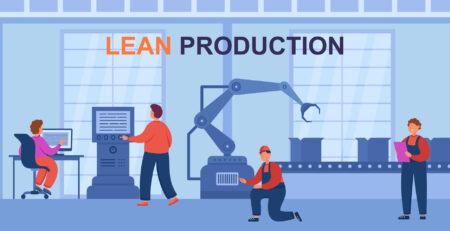
We had already talked about Lean Production in one of our very first articles: today we are going to delve deeper into the topic, the great lean method, going to list its 5 cornerstone principles. Every company in this day and age should learn to integrate the principles of the lean method into its workflow. These kinds of methodologies and improvement processes, embedded in the production processes, but also in those flows that concern the management and administration of an enterprise or organization, are methodologies, known as lean, which are now established today. Or rather-so they should be. In Italy we are still far from implementing this kind of
The worldwide success of the lean method, definitely began with lean production, or lean manufacturingwhich was later adapted to the needs of various sectors within the company.

The most well-known adaptation is certainly the lean management, thus covering the management and the administrative process of the company, but we also often talk about the more general concept of “lean thinking”.
The Birth of Lean Production
The boom of lean production was triggered by the text “The Machine That Changed the World: The Story of Lean Production” of 1990, a study by U.S. economists P. Womack, Roos and T. Jones, in which they go on to characterize the production system of the Toyota brand for the first time, going on to outline its extreme success in the world, recounting it for the first time in the West. For the first time the winning system, adopted in this case by the Japanese company, is appended with the name “lean production.”
Lean production, also known as Lean Production, thus aims to have a continuous improvement of various business processes and a reduction of time on the processing cycle. It is definitely about going to reduce waste of time and material, imbalances and overloads. But how to actually achieve the goals of the lean method?
Five principles theorized by Womack, Roos and Jones come to the rescue:
- added value for the customer
- value streams
- continuous flow of production
- pull principle
- Kaizen, the process of continuous improvement
1. Identify the product and define its value-from the customer’s point of view
The centrality of the customer in the lean method is of decisive importance, so the value of a product must be identified and defined from the customer’s point of view. That value is determined:
- from the quality
- from the price
- from adherence to delivery time
It is very important to remember that the entire process chain should be considered, thus including internal customers within the company, but that the focus should be especially on the end customers. Once the value from the end customer’s point of view has been defined-whether the product has been delivered as expected, at the right time, of the right quality and form-it is possible to understand which activities are necessary that actually go to create the added value or those activities that are actually superfluous.
2. The value streams of the lean method
2.1 Analysis and diagram
Value streams are defined as all those business processes required to produce, manufacture and bring a product to market. Only throughvalue stream analysis, otherwise known as Value Stream Mapping (VSM), it is possible to represent in detail the actual state of the processes and thus go on to visualize the value streams.
It is therefore necessary to go and analyze all the individual process steps, measure their times and visualize them through a flow chart. Before performing a value stream analysis properly, it is necessary to go and define some groups of similar products, which have the same production process, so that you can actually measure their values and compare them, thanks to their relative production steps.
The value stream diagram then allows a correct and effective result to be displayed, only after forming groups of similar products. Thanks to this diagram, it is possible to decipher which areas of the value streams that can be improved.

2.2 Creation of the value stream design
Phase one of the value streams is only for the purpose of analysis. The second phase aims to define a new theoretical standard for the processes examined. The first important thing to do is to work out a vision of the ideal state and then go on to rewrite the improvable processes. By making a flow chart of the improvable processes, the following opportunities are obtained:
- Shorten the delivery time;
- savings: reduce inventories by going accordingly to decrease capital employed;
- Greater flexibility between phases;
- Better responsiveness in dealing with all steps
At this point, following the principle of the continuous improvement process – also known as PMC-all employees of the company or organization work together to go on to define the desired standard, usually within a period of 3 to 6 months. After defining the standard, activities that do not contribute to value creation will be evident. In the lean production, this set of activities are called Muda – waste technologies – which, together with Walls – imbalance – and Walls – overload – constitute the 3Ms of the lean method.
Today we have absorbed some of the fundamental concepts of the Lean Production; we will stop here for now and finish discussing the last three fundamental points in a future article.
We at UTR srl provide consulting services in Tuscany and throughout Italy to help you and your company delve deeper into the lean method and try to make the leap required by the new competitive world of‘Industry 4.0. We design together with you but not only: we represent and distribute products and solutions of many companies that could help you in achieving the goal, toward a streamlining of processes within workflows, in the various sectors of your enterprise.
Contact us without obligation, we will be happy to help you.
For more on the subject visit this page on the ITEM website.