

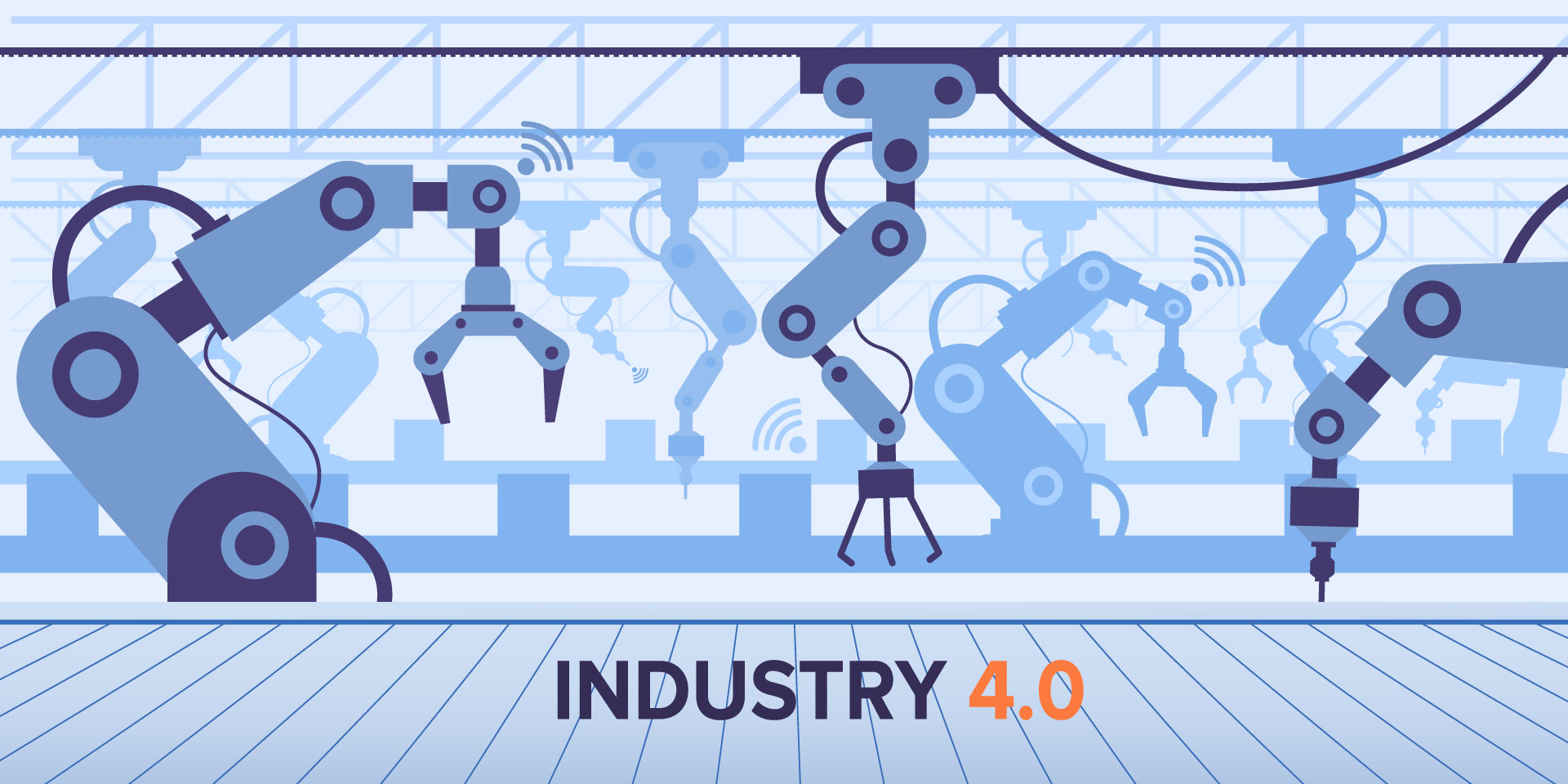
INDUSTRY 4.0: THE NEW INDUSTRIAL REVOLUTION
We hear a lot about Industry 4.0 in recent years, but let’s look specifically at what it is, starting with the definition:
The term Industry 4.0 (or Industry 4.0) refers to a trend in industrial automation that integrates some new production technologies to improve working conditions and increase the productivity and production quality of plants.
Industry 4.0 therefore goes hand in hand with innovation and the discovery of new smart technologies, in the industrial sphere.
How the entire industrial ecosystem in the Western world is changing
A flurry of innovation is spreading faster and faster among production systems around the world.
So far, there have been three industrial revolutions in the Western world:
- 1784: the birth of the steam engine and consequently the exploitation of water and steam power to mechanize production
- 1870: the increased use of oil as a new energy source, the increasing use of electricity with the start of mass production, the advent of the internal combustion engine
- 1970: Information technology was born, from which came the digital age, intended to increase automation levels by making use of electronic systems and IT
This new industrial revolution, the fourth, does not yet have a specific date, but we are finding ourselves living it just in the last few years, and it is becoming more and more evident.
It differs from the previous ones because it features the use within the production plant (in English plant) of “enabling technologies” -KET, key enabling technology. To wit. We are talking about those technological solutions and improvements that contain within them a lot of research and development and are able to breathe new life into the production system.
What are the enabling technologies of Industry 4.0?
The enabling technologies of Industry 4.0 are:
- Advanced robotics machinery equipped with artificial intelligence, interconnected, and rapidly programmable
- Augmented reality devices through which we enter a “parallel” reality, superimposed on our own
- Additive manufacturing 3D printing and digital fabrication in general
- Horizontal and vertical integration and interconnection all steps in the value chain communicate with each other, from producer to consumer
- Internet of things, the internet of things, but applied to industry: smart objects that can communicate data about themselves
- Cloud cloud management, on the network, of large amounts of data
- Big Data analytics
analysis of a large database necessary for the real-time production of useful information to optimize products and production processes - Cyber-Security
assurance of security during network operations and on cloud systems - Simulation the ability to simulate new processes related to production activity before actually putting them into practice

From the old factory concept, we have moved to the newsmart factory (smart factory), characterized by mostly digitized, dynamically functioning production, called brilliant manufacturing.
Processes are definitely more fluid, interconnected: production systems that adapt to modernity and its needs.
Process optimization, energy efficiency: producing more while wasting less.
For some insights dedicated to the world of Smart Automation Solution, we recommend you visit this page on the official website of LS Electric, a leader in the industrial automation industry.